

The Portland Decision
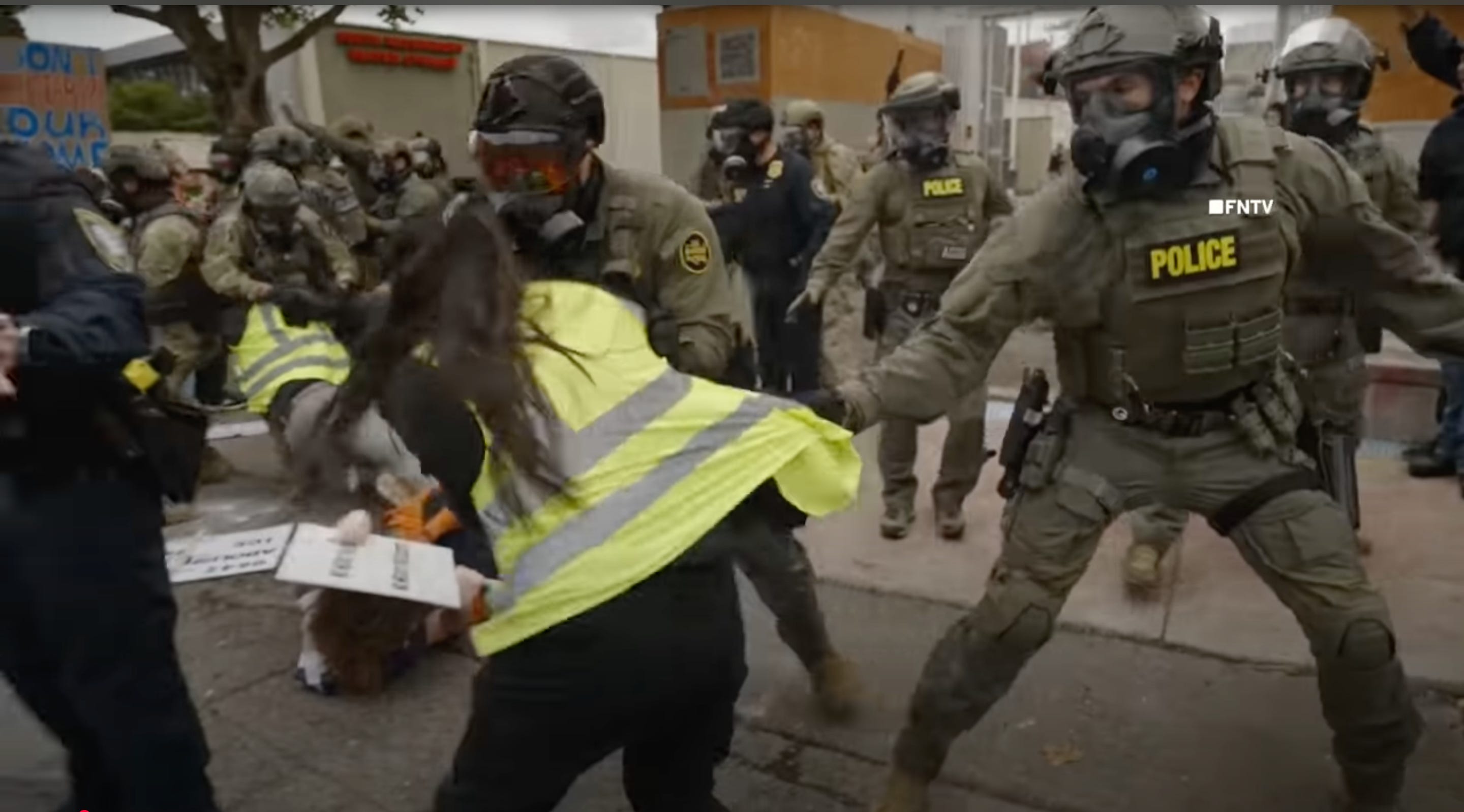
On October 4, 2025, U.S. District Judge Karin J. Immergut — appointed by President Donald Trump in 2019 — issued a temporary restraining order halting the administration’s attempt to federalize 200 Oregon National Guard troops for deployment to Portland.
That night, the order’s scope was narrow but its impact immediate: no federalized troops entered the city’s streets.
This Substack is reader-supported. To receive new posts and support my work, consider becoming a free or paid subscriber.
Immergut’s opinion, measured in tone and grounded in precedent, warned that accepting the White House’s rationale would
“blur the line between civil and military federal power,”
a phrase echoing more than two centuries of American unease about soldiers enforcing civilian law.
Then came the sentence that now defines the case — and may enter the civic lexicon:
“This is a nation of Constitutional law, not martial law.”
(Opinion and Order, p. 30)
That line carries both alarm and assurance — alarm because a presidency once again tested the boundary between leadership and dominion; assurance because a judge appointed by that same president affirmed that the Constitution still binds power.
In a political season defined by rhetoric and reprisal, the courthouse remained a steady light against the partisan noise.
Delusions v. Reality
President Trump had characterized Portland as “war-ravaged” and ordered troops to “stabilize the city.” His directive — cited in court filings — framed Portland as under siege by “Antifa and other domestic terrorists.”
Yet the record before Immergut showed otherwise: federal exhibits documented only “minimal activity outside the Portland ICE facility in the days preceding September 27.” Nothing suggested rebellion or failure of civilian law enforcement.
Thus, the case began not as a clash of ideologies but as a test of evidence. Immergut found the administration’s determination “untethered to the facts.”
It was a courtroom’s way of saying that rhetoric ends where the record begins.
Her order reaffirmed a simple principle: in a constitutional republic, facts — not fear — authorize force.
Legal Foundations & Ruling
Every democracy hides its limits within its laws, and every crisis tests whether those limits are still believed in. Judge Karin Immergut began where American law itself begins — with restraint.
A president may call a state’s National Guard into federal service only under the narrow conditions Congress has written: invasion, rebellion, or the proven inability of ordinary forces to keep the peace. Those limits, codified in 10 U.S.C. §12406, form the steel rails in the architecture of civilian control — the legal reminder that power must be borrowed, never seized.
In her opinion, Immergut walked through those gates one by one — invasion, rebellion, breakdown of order — and found each locked to the evidence before her. The record showed that federal agents were already functioning in Portland, that city police remained operational, and that the protests outside the ICE facility were small and sporadic. “The President’s determination was simply untethered to the facts,” she wrote (p. 23). In that line, law becomes character: evidence rebukes emotion, and fact itself becomes an act of restraint.
The administration next sought refuge in the word rebellion. Immergut paused over it, returning to first definitions. Quoting the statute’s nineteenth-century ancestors, she identified rebellion as something more than unrest — armed, organized, open, and aimed at overthrowing the government itself. Portland, she observed, was none of these. “The protests in Portland were not ‘a rebellion’ and did not pose a ‘danger of a rebellion,’” she concluded (p. 25). To treat scattered vandalism as insurrection, she warned, would collapse the distinction between protest and war — turning dissent into a pretext for militarization.
Having stripped away both claimed justifications, the court turned to the Tenth Amendment, where the Constitution speaks for the states. Immergut quoted Youngstown Sheet & Tube Co. v. Sawyer (1952): “A president’s power must stem either from an act of Congress or from the Constitution itself.” Here it stemmed from neither. By federalizing Oregon’s Guard without lawful cause, she held, the President had “undermine[d] the sovereign interest of Oregon as protected by the Tenth Amendment” (p. 27). In doing so, she restored an old foundation — the balance between Union and state, between command and consent.
Her logic echoed Justice Robert Jackson’s celebrated concurrence in Youngstown. Jackson described three zones of executive authority; Immergut’s decision resides in the third — the place where a president acts against Congress’s expressed will and thus at the “lowest ebb” of power. In that sense, her ruling was not merely procedural but architectural: it rebuilt the wall between civil government and the military that two centuries of American law have labored to keep upright.
The temporary restraining order that followed was narrow but decisive. It barred the federalization of Oregon’s Guard pending a full hearing later in October. Federal civilian officers could continue to protect property and personnel, but the soldiers would remain under state command. One judge’s pen — guided by statute rather than strategy — redrew the boundary that democratic caution had long etched in precedent. The armed forces, she reminded the nation, answer to the Constitution, not to convenience.
Historical & Comparative Context
Immergut’s reasoning did not arise in isolation. It joins a long American conversation about how far the armed hand of the state may reach into civil life — and how often the judiciary must pull it back.
Every generation redraws that line; every crisis tempts it outward. The courts, again and again, have been the steady hand that restores it.
The first of those guardrails came with the Posse Comitatus Act of 1878. Born from the bruises of Reconstruction, it forbade the Army — and later the Air Force — from enforcing domestic law unless Congress explicitly allowed it. The law was less about logistics than memory: a nation trying to unsee the soldiers who had once patrolled southern streets in uneasy peace. Immergut’s opinion breathes that same caution. When she warns that accepting the White House’s rationale would “blur the line between civil and military federal power,” she is not merely citing statute — she is invoking a century’s moral residue: the belief that liberty depends on keeping the saber out of the courthouse.
Seventy-four years later, another president tested that line. In 1952, amid a wartime labor strike, Harry Truman seized the nation’s steel mills without congressional approval. The Supreme Court rebuked him in Youngstown Sheet & Tube Co. v. Sawyer, a decision that has become the grammar of constitutional restraint. Justice Robert Jackson’s concurrence divided executive power into three zones: at its height when Congress agrees, uncertain when Congress is silent, and at its “lowest ebb” when Congress has spoken in opposition. Immergut’s ruling fits squarely in that third zone — the place where presidents must bow to law and where law reminds them of its primacy.
That American wariness toward domestic militarization has its echoes abroad.
Germany’s Basic Law forbids the Bundeswehr from policing its citizens except in the direst emergencies — a reaction to the militarism that once consumed Europe. South Korea’s Constitutional Court, shaped by its own long shadow of dictatorship, has ruled that troop deployments for civil control demand demonstrable necessity and legislative oversight.
Immergut’s order, though written in a single Western courtroom, now sits within that global jurisprudence of restraint: democracies survive not by trusting their leaders’ intentions, but by limiting their reach.
By tracing her logic through history and across borders, Immergut transformed a local dispute into a study in constitutional anatomy.
The question before her was never just Portland’s temperament — it was America’s equilibrium. In reaffirming that equilibrium, she reminded the nation of an old civic truth: restraint is not weakness; it is design.
Meaning & Implications
Immergut’s order is more than an injunction; it is a mirror held to the republic’s habits of power. It asks whether fear, repeated often enough, can become a constitutional argument. Her answer is quiet but absolute: law must remain the language of authority, not its disguise.
Every president faces the temptation of crisis rhetoric—the claim that exceptional times demand exceptional tools. Yet the law’s endurance depends on its refusal to be exceptional. Immergut’s opinion reminds that an emergency cannot be declared into existence; it must be proven. “A great level of deference,” she wrote, “is not equivalent to ignoring the facts on the ground” (p. 23). Those twelve words, unadorned and judicial, may prove as enduring as her more quotable line about constitutional law. They set a test for governance itself: deference is not blindness.
Her decision also exposes how political theater distorts the mechanics of law. When leaders label cities as “war-ravaged,” they do more than justify force—they recruit language into combat. Immergut’s opinion dismantles that tactic with methodical restraint. Where the President saw a battlefield, the judge saw a record. Where the administration invoked rebellion, she found ordinary dissent. And where executive rhetoric sought total command, she restored proportion.
The deeper significance of the ruling lies here: it turns constitutional procedure into civic pedagogy. By writing with precision rather than passion, Immergut teaches that democracy’s strength lies in process, not spectacle. A temporary restraining order may appear procedural, even mundane, yet within its brevity lives the entire architecture of accountability. Each citation—Youngstown, Sterling, Newsom, Bond—reminds that democracy endures through cumulative precedent, not singular will.
Its resonance reaches beyond Portland. In the federalist design, the states are not subsidiaries; they are co-sovereigns, each a sentry for the others. When Oregon asserts its right to control its Guard, it defends not only its own sovereignty but the principle that power must travel through lawful channels. Immergut’s injunction thus becomes a national mirror: the health of the whole depends on the courage of the parts.
Her restraint performs a second task—it calms the body politic. Amid polarization, it restores the rhythm of deliberation. Each paragraph’s cadence, built on evidence rather than invective, restores faith that institutions can still reason under pressure. In this sense, the opinion operates not only as law but as therapy for a frayed democracy—proof that even in an age of digital immediacy, government can still act at the tempo of thought.
When history revisits this case, the question will not be whether troops entered Portland—they did not—but whether the United States remembered how to stop itself. Immergut’s ruling offers one answer: a republic endures not through force, but through friction—the resistance that law applies to power.
The Importance of Portland
What is happening in Portland is not about a single city. It is a test of the nation’s nervous system — the reflex that decides whether power checks itself when the moment tempts overreach. The courthouse, granite and ordinary, has become the place where that reflex still fires.
Immergut’s opinion stands as both containment and signal — containment, because it halts a military move that exceeded its warrant; signal, because it shows that institutions can still speak with coherence amid political distortion.
“This is a nation of constitutional law, not martial law.”
The line is not decoration; it is instruction. It reminds us what must never be normalized — the belief that security can supersede legality, that the Constitution is optional when the streets grow loud.
The deeper truth revealed in Portland is that restraint is a civic act. To limit power, especially one’s own, is not weakness but proof of design.
Immergut’s decision is the latest chapter in that American tradition of limits —
the check that makes freedom real. Each time presidents test their reach and courts respond with reason, the country rehearses its founding argument once again.
And yet, the opinion also carries a warning. Each confrontation of this kind thins the republic’s capacity for restraint. Every invocation of “war” against dissent makes the next one easier. The line between emergency and opportunism grows faint.
What remains is faith in the idea that, for now, the architecture still holds —that even under pressure, the machinery of law can still turn against the weight of will.
Portland, then, is not a metaphor; it is a measurement. It measures how much truth still governs force. It measures whether constitutional order can still outlast personality. And it measures the distance between the noise of politics and the quiet persistence of an oath.
The light from that courthouse window may be small, but it has not gone out.
Reference List
Primary Judicial Document
State of Oregon & City of Portland v. Trump et al., No. 3:25-cv-01756-IM, Opinion and Order (U.S. District Court, District of Oregon, Oct 4 2025), pp. 22–31.
↳ https://storage.courtlistener.com/recap/gov.uscourts.ord.3:25-cv-01756-IM-Opinion-and-Order.pdf
Primary News & Legal Sources
Reuters — “US judge temporarily blocks Trump administration from deploying National Guard to Portland.” — October 4 2025
Washington Post — “Judge temporarily blocks Trump from deploying troops in Portland.” — October 4 2025
Oregon Public Broadcasting (OPB) — “Judge Immergut halts Trump order to federalize Oregon Guard.” — October 4 2025
Portland Mercury — “Federal Judge Grants Restraining Order Blocking Trump from Deploying Troops to Portland.” — October 4 2025
Statutory & Judicial Precedents
Sterling v. Constantin, 287 U.S. 378 (1932)
↳ https://supreme.justia.com/cases/federal/us/287/378/Bond v. United States, 564 U.S. 211 (2011)
↳ https://supreme.justia.com/cases/federal/us/564/211/Laird v. Tatum, 408 U.S. 1 (1972)
↳ https://supreme.justia.com/cases/federal/us/408/1/Newsom v. Trump II, 141 F.4th 1045 (9th Cir. 2025)
↳ https://casetext.com/case/newsom-v-trump-2Fischer v. United States, 603 U.S. 480 (2024)
↳ https://supreme.justia.com/cases/federal/us/603/480/Trump v. United States, 603 U.S. 593 (2024)
↳ https://supreme.justia.com/cases/federal/us/603/593/
Supplementary Context & Background
The Guardian — “Judge blocks Trump administration from deploying National Guard to Portland.” — October 5 2025
Associated Press — “Federal judge halts Trump plan to send National Guard troops to Portland.” — October 4 2025
Comparative / Global Context
Germany — Grundgesetz (Basic Law), Art. 87a — restricts domestic military use
↳ https://www.gesetze-im-internet.de/englisch_gg/englisch_gg.html#p0423Republic of Korea — Constitutional Court Decision 2004-Hun-Ba-60 — limits on internal troop deployment
↳ https://legal-info.kr/court/2004hunba60
The governors of Oregon and California should now announce that any federalized National Guard troops illegally setting foot in their states will be subject to arrest. Troops from their own states obeying such an illegal order would also be subject to reduction in rank and/or dismissal from military service—a punishment that will follow them throughout their civilian careers. This will create a showdown with Trump that will bring this issue to a head.