
Florida First Lady Suggests Horse Dewormer as Possible Cancer Treatment
At a Florida cancer event, Casey DeSantis suggested ivermectin — debunked as a COVID cure — despite fatal misuse cases showing the dangers of promoting the “horse dewormer” as medicine.

Pseudoscience as Policy
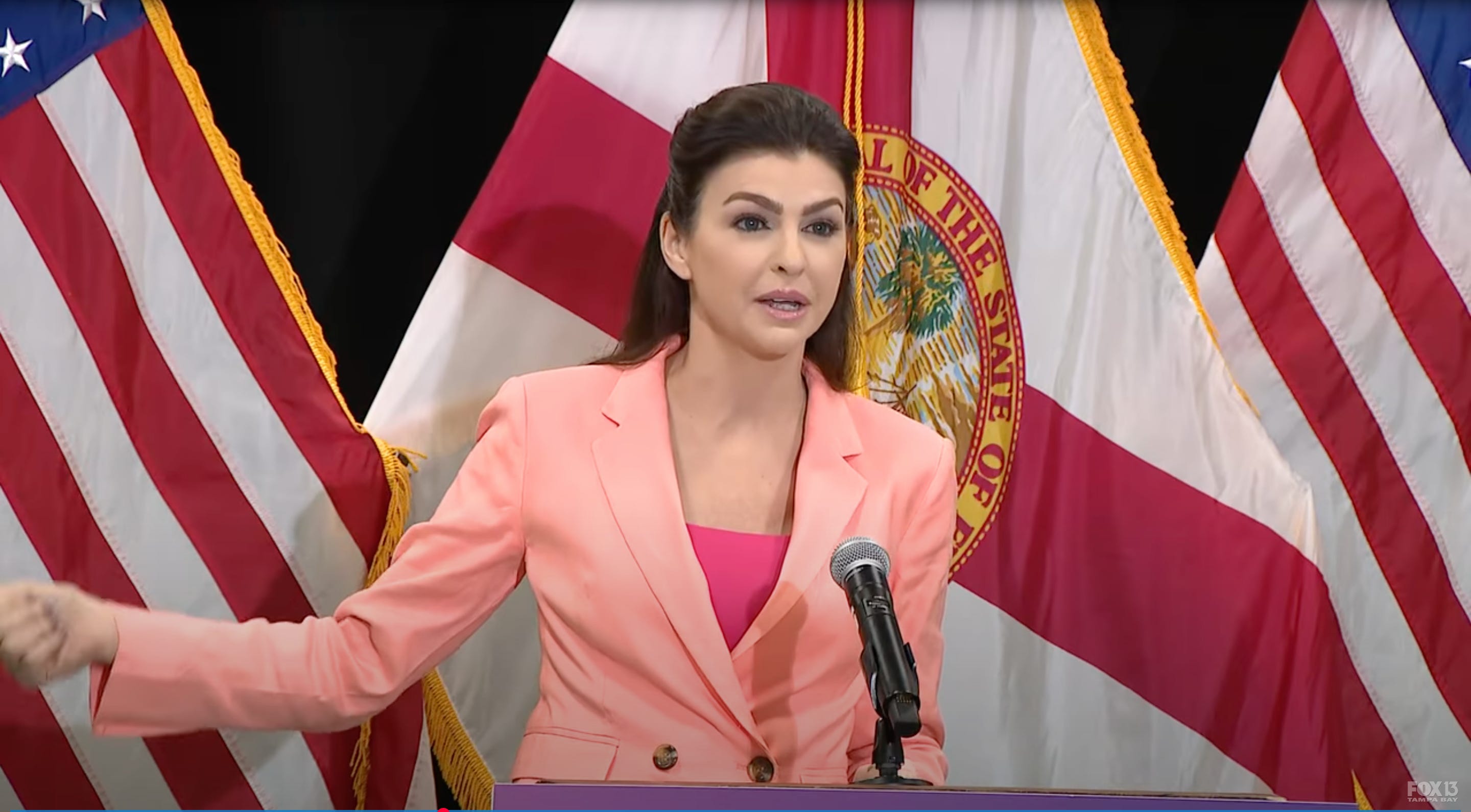
Casey DeSantis, Florida’s First Lady, spoke at a state-sponsored cancer symposium in Tampa in 2025, praising the state’s oncology funding before pointing to ivermectin as a drug Florida should consider for repurposing in cancer research.
The reference was brief, but its implications were large. What might seem an offhand remark aligned Florida’s billion-dollar cancer initiative with a familiar American pattern in which “miracle cures” become political symbols even when evidence shows they fail patients. In the 1970s, laetrile — an apricot-pit extract — was marketed as a cancer remedy despite National Cancer Institute trials showing no benefit and real risks of cyanide poisoning. More recently, hydroxychloroquine was promoted by President Donald Trump during COVID-19 as a “game-changer,” only to be disproved in large randomized clinical trials and linked to preventable harm.
Florida’s turn to ivermectin continues this lineage. The gamble is not only medical but civic: whether public institutions can withstand the idea that evidence is optional.
I. From Symposium to State Policy
In September 2025, Casey DeSantis spoke at the University of South Florida’s cancer symposium in Tampa, before an audience of physicians, researchers, and state officials. She highlighted the state’s billion-dollar commitment to oncology and emphasized prevention through diet and lifestyle. Then, drawing on both office and survivorship, she pointed to ivermectin — an antiparasitic drug the FDA has warned against for COVID-19 and which no regulator has approved for cancer treatment — as a generic the state “should look at” for possible repurposing.
“Facts do not cease to exist because they are ignored.” ― Aldous Huxley, Complete Essays, Vol. II: 1926-1929
That gesture placed ivermectin, once promoted as a populist panacea, inside Florida’s innovation agenda. While not a policy in itself, it signaled that official rhetoric could bend against consensus science.
Such moves have precedents.
In 1721, Cotton Mather defended smallpox inoculation with scripture and statistics, while critics denounced it as sorcery.
In 1847, Ignaz Semmelweis urged physicians to wash their hands, only to be dismissed and confined to an asylum.
A century later, Soviet biologist Trofim Lysenko denounced genetics as “bourgeois pseudoscience,” crippling Soviet biology for decades.
Florida’s invocation of ivermectin joins this lineage: moments when authority, faced with evidence, chose ideology.
Fact-Box: Laetrile Ban (1977)
FDA declared laetrile unsafe and unapproved.
NCI trial with 178 patients: no benefit; frequent cyanide toxicity.
Families spent millions seeking treatment in Mexico; some died after delaying chemotherapy.
FDA conclusion: “No credible evidence of effectiveness. Risk of serious poisoning.”
II. From Wellness Rhetoric to Public Doctrine
The Tampa address was framed as part of a billion-dollar research initiative, but its language leaned less on trial design than on wellness tropes: eat better, exercise, make different choices.
Such advice is harmless on its own, yet in American politics it often carries a moral undertone: health as discipline, illness as lapse.
As both First Lady and cancer survivor, Casey DeSantis gave this rhetoric added weight.
She tapped a tradition in which women’s illness is recast as inspiration — from Betty Ford’s candor about breast cancer to Nancy Reagan’s personal appeals. Paired with a reference to ivermectin, the message shifted from symbolic to prescriptive: a low-cost outsider drug presented as promising, even suppressed.
Economic appeal sharpened the point.
Alternative cures often market themselves as democratic answers to “Big Pharma,” suggesting that cheap remedies must also be liberating.
Laetrile in the 1970s played this role. Marketed as a people’s cure, it drained savings, delayed proven treatment, and sent patients to Mexican clinics where studies later found no benefit and clear risks.
What once belonged to fringe salesmen now echoes from state podiums. Skepticism of consensus has been recast as doctrine — no longer private belief, but public policy in the name of innovation.
III. What Evidence Demands
The scientific record is clear: no randomized clinical trial has shown that ivermectin treats cancer in humans.
As of 2025, systematic reviews in Current Oncology Reports and Acta Poloniae Pharmaceutica reach the same conclusion: laboratory studies show some anti-tumor effects, but no human trials confirm them.
“The aim of totalitarian education has never been to instill convictions but to destroy the capacity to form any.”
— Hannah Arendt, The Origins of Totalitarianism (1951).
At doses high enough to mirror lab effects, toxicity rises sharply. Reported outcomes include seizures, confusion, and liver injury. During COVID-19, U.S. poison-control centers saw a fourfold jump in ivermectin-related calls, prompting the FDA’s now-famous warning: “You are not a horse. You are not a cow. Seriously, y’all. Stop it.”
Consider a patient with early-stage breast cancer who, persuaded by rhetoric about “cheap miracles,” delays chemotherapy to try ivermectin. By the time she returns, her disease has metastasized. This is hypothetical, but the mechanism was tragically real during the laetrile era, when delays often cost patients their chance at survival.
Repurposed drugs can succeed — but only through rigorous trials.
Thalidomide, notorious for birth defects, became an established treatment for multiple myeloma only after years of controlled study.
Beta-blockers, designed for heart disease, later proved useful in oncology.
None were revealed from lecterns. Science advances beam by beam, trial by trial, until uncertainty yields to trust.
IV. The Ghosts of Miracle Cures
The hydroxychloroquine episode showed how a drug can become symbol more than therapy. Promoted in 2020 by President Donald Trump as a “game-changer,” it soon vanished from pharmacies, leaving lupus and arthritis patients without medication.
By midyear, trials rendered their verdict. The U.K.’s RECOVERY trial with over 11,000 patients, a U.S. outpatient study in NEJM, and the WHO’s Solidarity trial all agreed: no benefit, heightened cardiac risks. The FDA revoked its emergency use authorization in June 2020. Analysts later warned that misplaced reliance contributed to preventable harm.
“Falsehood flies, and the Truth comes limping after it.” — Jonathan Swift, The Examiner No. 15 (1710)
Yet hydroxychloroquine’s force was never just pharmacological. It became a cultural emblem, a way to signal defiance of experts and loyalty to leadership. Trump’s refrain — “What do you have to lose?” — condensed the politics of miracle cures: simplicity in place of evidence, at the cost of safety.
Florida’s nod to ivermectin reprises this script. Nor is it unique.
In Brazil, Jair Bolsonaro pushed chloroquine long after data showed harm; a 2025 study in BMC Public Health found surging use without benefit. In India, the government endorsed Ayurvedic remedies lacking trials. In Hungary, Viktor Orbán framed vaccine choice as sovereignty against Europe.
The choreography is consistent: leaders elevate cures as nationalist emblems, converting distrust of institutions into loyalty to power.
For cancer patients, delay is not preference but prognosis.
To summon the ghosts of laetrile and hydroxychloroquine is to risk lives for theater.
V. The Machinery of Doubt
If Casey DeSantis provides symbols, Surgeon General Joseph Ladapo supplies structure. A Harvard-trained physician with both an M.D. and a Ph.D. in health policy, Ladapo taught at UCLA before his 2021 appointment as Florida’s top health official and now holds a professorship at the University of Florida. Since taking office, he has advanced policies that recast skepticism as liberty. In September 2025, he proposed eliminating all childhood vaccine mandates — unprecedented in modern U.S. public health — and compared mandates to “slavery,” a claim PolitiFact judged false.
The consequences are already visible. Florida’s kindergarten vaccination rates have fallen, in some areas slipping below 90 percent, beneath the 95 percent generally required for herd immunity. The American Academy of Pediatrics has warned that continued decline will open the door to outbreaks of measles, pertussis, and polio.
The inequities are stark. Black Floridians, long shaped by histories such as the Tuskegee syphilis study, have enduring reasons for distrust.
To liken mandates to slavery risks weaponizing that history, eroding trust in the very communities most exposed. Class divides compound the risk: affluent families can rely on private care or alternative schooling, while working-class families cannot.
This is a case study in the weaponization of credentials. Ladapo’s degrees and academic standing confer authority, yet here they are deployed to legitimize positions outside scientific consensus.
“Above all, don’t lie to yourself. The man who lies to himself and listens to his own lie comes to a point that he cannot distinguish the truth within him, or around him, and so loses all respect for himself and for others. And having no respect he ceases to love.” — Fyodor Dostoevsky, The Brothers Karamazov (1880)
Once amplified by the state, such doubt hardens into doctrine. Its consequences are measured not in abstractions but in outbreaks, hospitalizations, and preventable deaths.
VI. The Fragile Inheritance of Science
For most of history, life was short. Around 1800, average U.S. life expectancy was 39 years; in much of Europe, closer to 35. Nearly half of children died before age ten, often from diseases blamed on curses or “bad air.”
Science altered that path not with sudden revelations but with method. In the 1840s, Ignaz Semmelweis showed that handwashing reduced maternal deaths, yet he was dismissed and later confined to an asylum, where he died in 1865. Florence Nightingale used systematic data collection and statistical diagrams to show that sanitation could save soldiers in the Crimean War. Louis Pasteur demonstrated that microbes, not miasmas, caused disease. Each advance was fragile, contested, slow.
Because evidence is provisional, science can seem hesitant; because it is cautious, it can seem weak. In those gaps, pseudoscience thrives, promising speed and certainty.
Science is not a miracle pill but an infrastructure: protocols, peer review, regulation. These are the beams that carry societies across doubt.
Remove one — a mandate, a safety rule — and the bridge may still stand. But erosion builds, and collapse, when it comes, is sudden.
Fact-Box: Semmelweis’s Fate
Ignaz Semmelweis (1818–1865), pioneer of antiseptic handwashing.
Ridiculed and dismissed by peers.
Institutionalized in 1865, died from injuries while confined.
Posthumously recognized as “savior of mothers.”
VII. Democracy on Trial
At the Tampa symposium, applause was polite but restrained. Suspicion of science had moved from margins to machinery of state. Florida calls its initiative hope; in practice, it stages hope as spectacle.
The stakes are not confined to oncology.
Once evidence is treated as optional in medicine, the same logic can spread to classrooms, courts, even ballot counts. The disbelief that corrodes hospitals can also hollow democracies.
Science has given societies their longest lives; pseudoscience has offered only detours and preventable deaths.
“Freedom is the freedom to say that two plus two make four. If that is granted, all else follows.” — George Orwell, 1984 (1949)
This conflict is lived, not abstract: in schools where measles resurfaces, in clinics where delayed treatment narrows survival, in homes where parents weigh doctors’ counsel against politicians’ claims.
Democracy, like science, rests on fragile trust. Laws, institutions, and norms are its supports. Remove them, and the collapse is not gradual but sudden.
Florida may believe it is fighting cancer. In truth, it is testing whether democracy can survive when evidence is no longer binding.
History offers little comfort: societies that choose spectacle over evidence rarely endure. Collapse, when it comes, is swift.
Master Reference List
American Academy of Pediatrics. The Importance of Childhood Immunizations. Pediatrics, 2024.
https://www.aap.org/en/advocacy/state-advocacy/childhood-immunizations/?srsltid=AfmBOoq0lJjU-pTXaVET3_9QyRXuWFy0HHZWyqoXf9fGqLQQ_dZ0Qg6jBMC Public Health. Caetano R, et al. Political promotion of unproven therapies during COVID-19 in Brazil. 2025.
https://bmcpublichealth.biomedcentral.com/articles/10.1186/s12889-025-21712-9CBS Miami. Florida’s move to end vaccine mandates sparks political and medical clash. September 2025.
https://www.cbsnews.com/miami/news/florida-vaccine-mandate-elimination-desantis-ladapo-backlash/CDC. Measles cases and outbreaks. 2024.
https://www.cdc.gov/measles/cases-outbreaks.htmlCDC. Vaccination Coverage Among Children in Kindergarten — United States, 2022–23 School Year. MMWR, January 2024.
https://www.cdc.gov/mmwr/volumes/73/wr/mm7303a2.htmCreative Loafing Tampa. Florida Surgeon General Joseph Ladapo’s pharmacy board will discuss vaccines this month. September 2025.
https://www.cltampa.com/news/florida-surgeon-general-joseph-ladapos-pharmacy-board-will-discuss-vaccines-this-monthFDA. FDA Bans Laetrile as Unsafe and Ineffective Cancer Therapy. 1977.
https://digitalcommons.law.utulsa.edu/cgi/viewcontent.cgi?article=1460&context=tlrFDA. Safety Alert: Ivermectin Misuse and COVID-19. August 2021.
https://www.fda.gov/news-events/press-announcements/coronavirus-covid-19-update-august-31-2021FDA. Revocation of EUA for chloroquine and hydroxychloroquine. June 15, 2020.
https://www.fda.gov/media/138945/downloadFOX13 Tampa Bay. Governor Ron DeSantis gives an update on how Florida will spend funds on cancer research. YouTube, Sept 2025.
Lai Y, Guan X, Chen X, Chen J, Zhang X, Lu M. A Review of Ivermectin Use in Cancer Patients: Is It Time to Repurpose? Acta Poloniae Pharmaceutica – Drug Research, Vol. 81 No. 6, April 2025.
https://www.researchgate.net/publication/390635262_A_Review_of_Ivermectin_Use_in_Cancer_Patients_Is_it_Time_to_Repurpose_the_Ivermectin_in_Cancer_TreatmentNational Cancer Institute. Laetrile/Amygdalin (PDQ®)–Patient Version. 1980.
https://www.cancer.gov/about-cancer/treatment/cam/patient/laetrile-pdqNew York Post. Florida surgeon general says he didn’t study whether eliminating vaccine mandates would increase disease. September 7, 2025.
https://nypost.com/2025/09/07/us-news/fla-surgeon-general-says-he-didnt-study-whether-eliminating-vaccine-mandates-would-increase-disease/Nuland, S.B. The Doctors’ Plague: Germs, Childbed Fever, and the Strange Story of Ignac Semmelweis. 2003.
https://wwnorton.com/books/9780393326253Our World in Data. Life expectancy. (Global, U.S., Europe c. 1800).
https://ourworldindata.org/life-expectancyPasteur Institute. Louis Pasteur: Life and Achievements.
https://www.pasteur.fr/en/institut-pasteur/historyPolitico. Florida moves to scrap state school vaccine requirements. September 3, 2025.
https://www.politico.com/news/2025/09/03/florida-scrap-school-vaccine-requirements-00541739PolitiFact. School vaccine rules are not like slavery. Fact-checking Florida’s Surgeon General Joseph Ladapo. September 4, 2025.
https://www.politifact.com/factchecks/2025/sep/04/joseph-ladapo/Florida-vaccine-mandate-desantis-slavery/Rajkumar SV, et al. Thalidomide and multiple myeloma. NEJM, 2006.
https://www.nejm.org/doi/full/10.1056/NEJMoa053583RECOVERY Collaborative Group (Oxford). Effect of Hydroxychloroquine in Hospitalized Patients with COVID-19. NEJM, 2020.
https://www.nejm.org/doi/full/10.1056/NEJMoa2022926Reuters. Florida to end all state vaccine mandates, including for schools. September 4, 2025.
https://www.reuters.com/business/healthcare-pharmaceuticals/florida-plans-end-all-state-vaccine-mandates-including-schools-2025-09-03/ScienceDirect. Ivermectin and Gynecologic Cancer: What Are the Data? Gynecologic Oncology Reports, 2025.
https://www.sciencedirect.com/science/article/pii/S2352578925001286Springer. Ivermectin in Cancer Treatment: Should Healthcare Providers Caution or Repurpose? Current Oncology Reports, 2025.
https://link.springer.com/article/10.1007/s11912-025-01704-zWhite House Briefing. Donald Trump: “What do you have to lose?” April 4, 2020.
https://trumpwhitehouse.archives.gov/briefings-statements/remarks-president-trump-vice-president-pence-members-coronavirus-task-force-press-briefing-20/World Health Organization. Solidarity Trial Results on Hydroxychloroquine. 2020.
https://www.who.int/emergencies/diseases/novel-coronavirus-2019/global-research-on-novel-coronavirus-2019-ncov/solidarity-clinical-trial-for-covid-19-treatmentsWUSF. Florida working to eliminate all childhood vaccine mandates. September 3, 2025.
https://www.wusf.org/health-news-florida/2025-09-03/florida-to-eliminate-childhood-vaccine-mandates
These people are fucking insane….Sorry just responding to the headline. Rather than blaming Tylenol for autism, maybe we should have a study regarding why maga are insane, and so stupid‼️
As someone whose parent bought the myth that ivermectin can cure their cancer, and watched treatable cancer turn into stage 4 untreatable cancer. These lies just piss me off. Because of these lies my parent believed the ivermectin hucksters over the Mayo clinic, and now is going to die earlier than they should have because of it.